First purchase with a 10% discount, use promo code: NEW10
First purchase with a 10% discount, use promo code: NEW10

There is no such thing as a single “correct” skin-care routine, but there’s definitely an optimal way to apply your products. Whether you’re a minimalist who prefers sticking to a three-step routine or the type of person willing to undertake 11 steps daily in pursuit of glass skin, the way you layer your chosen products has a big impact on how well they work. The more product-intense you go, the more important this order becomes.
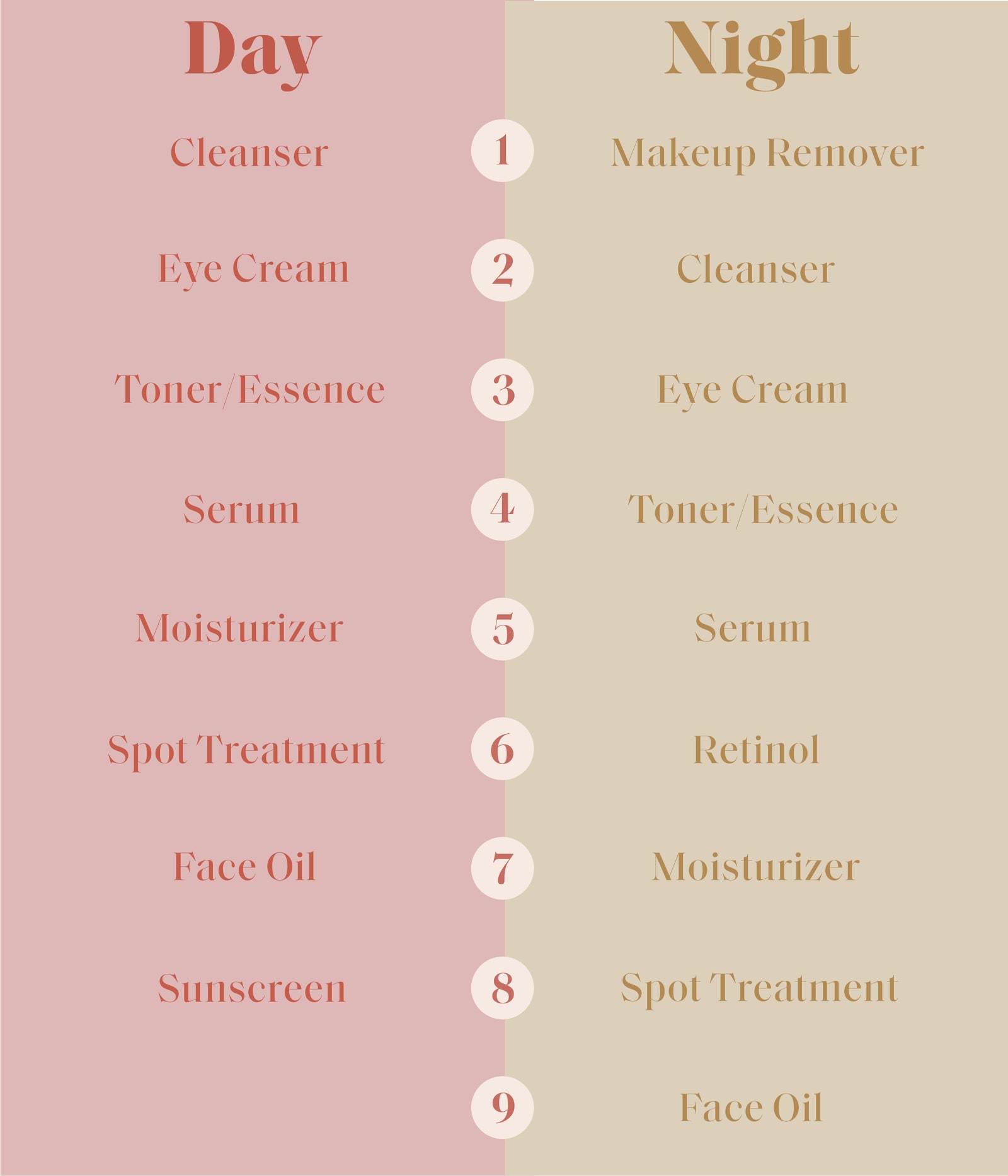
Do this step: At night only.
Unless you went to bed with makeup on (please don’t), there’s no reason to do this step in the morning. But at night it makes your cleanser’s job a lot easier.
Do this step: Morning and night.
Now that your makeup layer is gone, you can proceed with washing your face. “A cleanser gets rid of dead skin, pollutants, oils, dirt, and bacteria,” recommend also doing this step when you first wake up in the morning, in order to prep your skin to absorb the active ingredients in your other products.
Do this step: Morning and night.
The first product to go on your face? Eye cream. The reason is simple—because you’ll probably forget to do it otherwise. recommend patting eye cream on gently with your ring finger (this way you’ll tug less at the delicate skin there) all the way around your eyes, not just underneath them. If you’re worried about eye cream causing your concealer or eye makeup to smear, choose a more lightweight option, like a hydrating gel that sinks in quickly and stays put.
Do this step: Morning and night.
Both toners and essences are meant to help further prime your skin to absorb active ingredients, but the one you choose will depend on your skin type. Old-school toners were meant to balance skin pH and counteract alkaline soaps, before soap-free cleansers became popular. Now toner usually refers to liquid formulations geared toward oily skin that’s in need of gentle exfoliation and resurfacing, with oily or acne-prone skin should look for toners with ingredients like glycolic or salicylic acid.
Do this step: Morning and night.
This is the step where you’ll deliver the bulk of active ingredients to your toner/essence-primed face, and it’s important to do it early on in your routine. “Serums are formulated with smaller molecular-weight actives so they penetrate into deeper skin layers,”. “If you apply your serum after a thicker formulation, the active ingredients may not penetrate as well.”
Do this step: Morning and night.
This is the step where you’ll deliver the bulk of active ingredients to your toner/essence-primed face, and it’s important to do it early on in your routine. “Serums are formulated with smaller molecular-weight actives so they penetrate into deeper skin layers,”. “If you apply your serum after a thicker formulation, the active ingredients may not penetrate as well.”
Do this step: At night only.
Retinol truly deserves its own essay, but the short version is this: The vitamin A derivative boosts collagen production and increases the rate of cellular turnover. “Retinol reduces fine lines, reduces pore size, increases collagen and elastin production, takes off dead skin, reduces oil production, unclogs pores, and evens out skin tone”. Whether you want to clear breakouts or fade fine lines—or basically do anything to your face—retinol is your friend.
Do this step: Morning and night.
Moisturizers are there to simultaneously hydrate and seal in hydration, which is why these formulas tend to be heavier than the layers that go underneath. “You should use moisturizers with humectants like glycerin and hyaluronic acid, which pull in water,”. “I also recommend looking for ceramides, which seal the outer layers of skin.”
Do this step: Morning and night.
You need to use spot treatments on active breakouts only, but if you’re experiencing acne, you can apply a leave-on spot treatment both morning and night to speed up its healing cycle. You should spot-treat after you’ve applied your moisturizer, not before. This helps make sure the product stays on top of the pimple, and doesn’t go on the rest of your face. “If you’re using a strong acid and then smear moisturizer all over your face, you run the risk of the product getting on more sensitive areas”. You’ll also dilute its effectiveness. Wait for your a.m./p.m. moisturizer to sink in, then carefully pat over the affected areas.
Do this step: Morning and night.
If there’s one step in your daily skin-care routine that surprisingly divides experts, it’s face oil. The most common recommendation is to apply it last at night and second-to-last before sunscreen in the morning. That’s because oils are occlusive, dermatologist and associate clinical professor at Yale School of Medicine. Meaning, they help trap moisture in your skin. “Oils provide a protective barrier to help prevent moisture from evaporating,” “Anything applied over it may not be offering as much benefit to your skin because it can’t get through.”
Do this step: In the morning only.
What dorms unanimously agree on is that you should wear sunscreen every single day to prevent UV damage—whether or not you go outside. Sunscreen needs to go over face oil in order to be most effective. “You do not want anything to stop the sunscreen from working, or making it less effective”. “Putting an oil on top of your sunscreen can decrease it’s efficacy”.

Methods of Delivery
Cash On Deliver, Visa, Master

AUTHENTIC & CONTROLLED
PRODUCTS

FREE SAMPLES
In Every Order

FAST DELIVERY WITHEN 24H

No account yet?
Create an Account